
NEC Article 625 EV Charging Requirements
A practical guide to National Electrical Code Article 625 for electrical contractors, facility managers, and installers working on commercial EV charging projects. Understand disconnect identification, labeling requirements, and material considerations.
What is NEC Article 625?
The National Electrical Code (NEC) Article 625 governs Electric Vehicle Power Transfer Systems, including the electrical installation of EV charging equipment (EVSE — Electric Vehicle Supply Equipment). Article 625 addresses installation requirements, disconnect identification, marking requirements, and safety considerations for electric vehicle charging infrastructure.
Article 625 applies to installations covered by the NEC, including commercial EV charging stations, multi-unit residential installations, workplace charging, and public parking facility charging. Different sections address specific installation types, equipment classifications, and safety identification requirements.
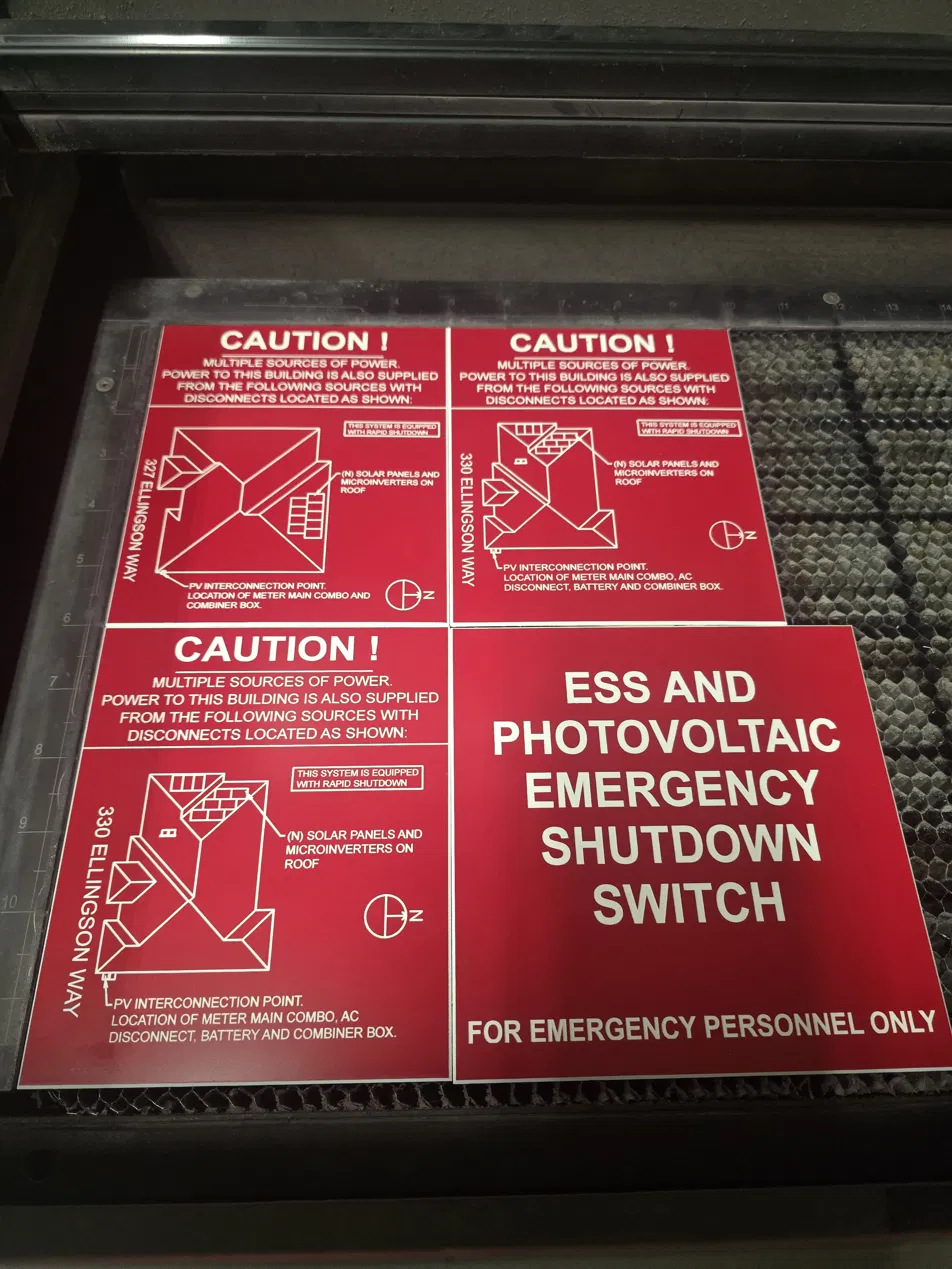
We manufacture engraved identification for EV charging installations to your project specifications. This guide provides an overview of key identification considerations under NEC 625 to help you plan your project — always confirm specific requirements with your electrical engineer, contractor, or the authority having jurisdiction (your local inspector or code official).
EV Charger Disconnect Requirements Under NEC 625.43
NEC 625.43 requires a disconnecting means for EV supply equipment (EVSE) rated more than 60 amperes or more than 150 volts to ground. The disconnect must be readily accessible and lockable in the open position per NEC 110.25. Where practical, the disconnect is installed within sight of the EVSE; otherwise it must comply with the section's remote-disconnect provisions.
For EVSE rated 60 amperes or less and 150 volts to ground or less, the branch circuit overcurrent device can serve as the disconnect, provided it is within sight of the EVSE or lockable in the open position. This exception covers most residential Level 2 installations, where the panel breaker meets the requirement.
NEC 2026 significantly expanded Section 625.43 for commercial and multifamily installations with an emergency disconnect requirement covered in a separate section below. Applicability of NEC 2026 versus earlier editions depends on the code edition adopted by your authority having jurisdiction.
We manufacture engraved disconnect identification to your project specifications — including AC disconnect labels, emergency disconnect placards, location plaques, and enclosure markings. For product ordering and material options, see our EV charger disconnect labels page.
Does an EV Charger Need a Disconnect?
An EV charger needs a disconnect when the EVSE is rated more than 60 amperes or more than 150 volts to ground per NEC 625.43. For EVSE rated 60 amperes or less and 150 volts to ground or less, the branch circuit overcurrent device can serve as the disconnect if it is within sight of the EVSE or lockable in the open position.
Common installation categories:
- Level 1 (120V, up to 20A): No dedicated disconnect required in most cases — the branch circuit breaker serves the purpose.
- Level 2 residential (32–48A): Dedicated disconnect required only if the EVSE exceeds 60A or 150V to ground.
- Level 2 commercial (over 60A): Dedicated readily accessible, lockable disconnect required.
- Level 3 DC fast charging (typically 480V): Full disconnect required, always.
NEC 2026 adds an emergency disconnect requirement at commercial and multifamily installations regardless of amperage — see the NEC 2026 Emergency Disconnect section below for details. Applicability of specific requirements depends on your installation type and the code edition adopted in your jurisdiction.
NEC 2026 Emergency Disconnect Labels
NEC 2026 Section 625.43 expanded emergency disconnect requirements for permanently installed EVSE at commercial and multifamily installations. The required label carries specific two-line wording:
- Line 1: EVSE EMERGENCY DISCONNECT
- Line 2: WARNING: ELECTRIC VEHICLE(S) WILL REMAIN ENERGIZED
The disconnect is required to be located 20–100 feet from the EVSE and in sight of the equipment. One- and two-family dwellings are exempt. We manufacture engraved emergency disconnect labels to the NEC 2026 format and wording. Applicability of NEC 2026 versus earlier editions depends on the code edition adopted in your jurisdiction — confirm with your project engineer and local inspector.
Who this guide is for.
This guide is written for:
- Electrical contractors installing commercial EV charging equipment
- Facility managers responsible for EV charging installations at commercial properties
- Property developers planning EV-ready or EV-installed facilities
- General contractors coordinating EV charging installation projects
- Engineers specifying identification requirements for EV charging systems
If you're planning an EV charging installation, this guide helps you understand identification and labeling considerations before purchasing materials or submitting for jurisdictional review.
Key identification considerations under NEC 625.
These summaries are general and edition-dependent. Code language changes between cycles, and your jurisdiction may have adopted a different edition. Confirm the governing requirement with your project documents and your local inspector before ordering.
Disconnect identification
Related products: Engraved AC disconnect labels, emergency disconnect placards, and disconnect schedule identification for multi-station commercial installations — see EV Charger Disconnect Labels.
Equipment marking and identification
Related products: Engraved equipment identification tags, voltage plates, and permanent circuit identification — see EV Charging Labels & Placards.
Source-of-supply identification
Related products: Engraved source-of-supply labels for feeder panels and electrical service equipment.
Warning and safety identification
Related products: Engraved warning placards, arc flash labels, and emergency shutdown identification.
Materials for EV charging identification.
Material selection for EV charging identification depends on the installation environment. Commercial EV charging installations are typically outdoor or exposed to significant environmental variation, which affects material durability requirements.
Available material considerations include:
- Engraved phenolic/plastic — UL 94-rated materials for documented flammability performance, outdoor-rated variants for weather exposure
- Engraved brass — durable metal identification for permanent equipment marking
- Engraved aluminum — lightweight, durable, suitable for outdoor mounting
- Engraved stainless steel — corrosion resistance for harsh environments
We manufacture engraved identification in all of the above materials. Material recommendations are based on your specific installation environment and project requirements.
California EV charging identification requirements.
California has adopted specific requirements for commercial EV charging installations under Title 24 (California Energy Code), the California Electrical Code (Title 24 Part 3), and local jurisdiction amendments. California EV charging installations typically require:
- Compliance with the California Electrical Code (which adopts NEC with California-specific amendments)
- Compliance with Title 24 accessibility requirements for EV charging in commercial and multi-unit developments
- Local jurisdiction requirements which may exceed state minimums
Specific identification requirements for California EV charging projects should be confirmed with your local inspector, your project engineer, and your electrical contractor.
We are based in Chico, California and manufacture engraved identification to specifications supplied for California EV charging projects, including jurisdiction-specific wording and California-adopted code references.
Commercial vs residential EV charging identification.
NEC 625 requirements apply to both commercial and residential EV charging installations, but identification requirements differ significantly:
Residential installations
- Simpler disconnect identification requirements
- Typically single-charger installations
- Basic panel labeling for the EV charging circuit
- Minimal warning identification
Commercial installations
- Multi-station disconnect schedules
- Source-of-supply identification on feeder panels
- Individual charger identification and station numbering
- Extensive warning and safety identification
- Weather-durable materials for outdoor installations
- Higher volume of identification per project
We serve both markets but specialize in commercial-scale identification projects where multi-station complexity, weather-durable materials, and engraved identification are required.
Engraved identification produced every business day.
We manufacture engraved compliance identification every business day from our Chico, California facility. We produce identification for EV charging projects, utility installations, industrial facilities, and commercial buildings — engraved compliance identification since 1982.
Our engraved EV charging identification.
EV Charger Disconnect Labels
EV Charging Labels & Placards
Frequently asked questions about NEC 625.
Does NEC 625 apply to all EV charging installations?
What NEC edition applies to my project?
Where can I find the exact wording required for EV charger disconnect labels?
What materials meet NEC durability requirements for outdoor EV charging?
Do you offer engineering or code interpretation services?
Can you supply identification for a large multi-station EV charging installation?
Does an EV charger need a disconnect?
When does NEC 2026 require an EVSE emergency disconnect?
What's the difference between a disconnect and an emergency disconnect for EV charging?
Planning an EV charging project?
Whether you have complete specifications or you're still figuring out what your project needs, we can help. Send your project details for a quote, or call to discuss your EV charging identification requirements.