
NFPA 855 Requirements for BESS and Energy Storage
A guide to NFPA 855 signage and emergency responder identification for battery energy storage systems, covering UL 9540, UL 9540A, NEC Article 706, and the 2026 edition changes.
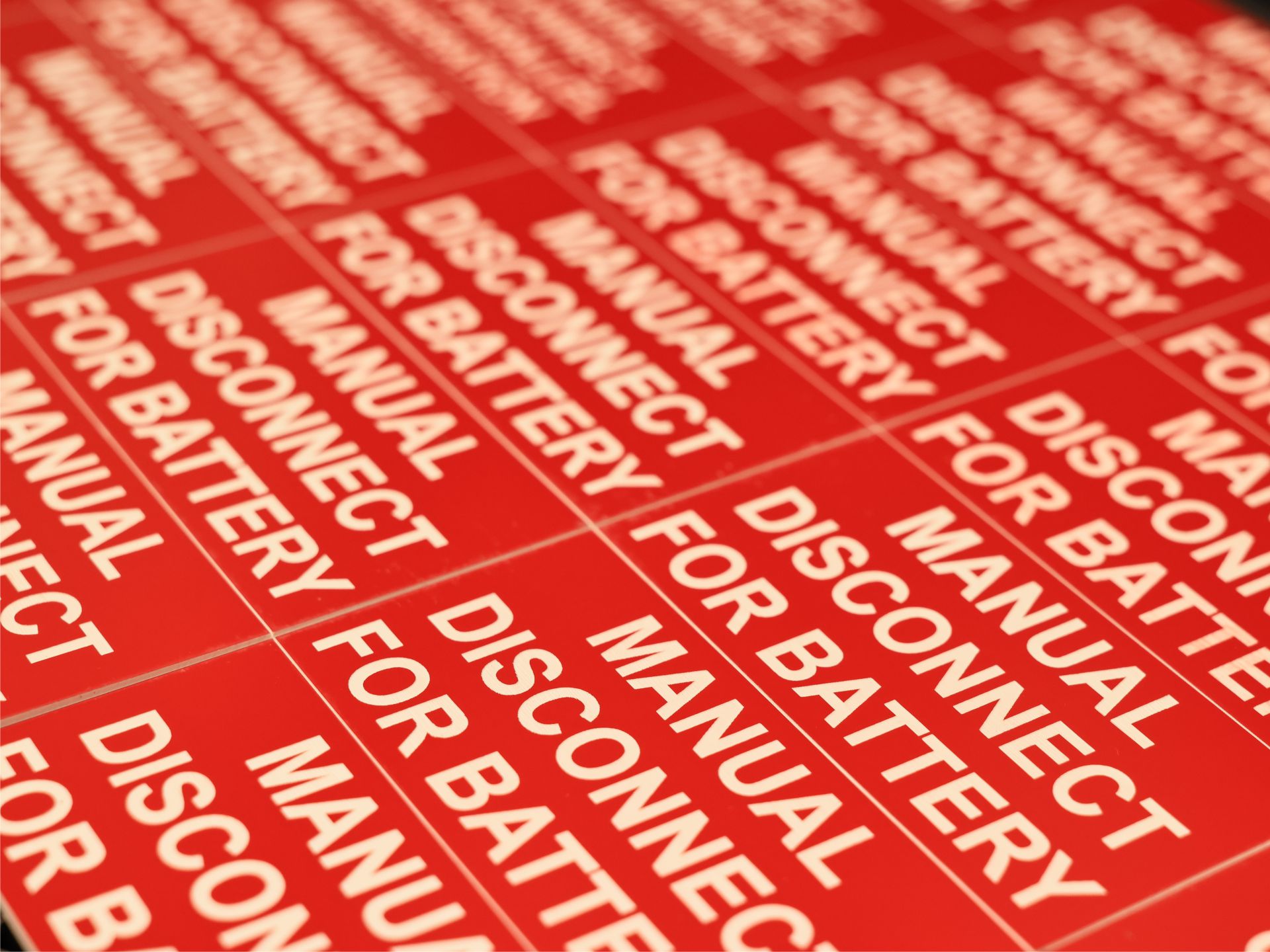
NFPA 855 is the U.S. installation standard for stationary energy storage systems (ESS), including battery energy storage systems (BESS). Published by the National Fire Protection Association, it applies to essentially all commercial, industrial, and utility-scale battery storage installations — any stationary ESS with aggregate energy capacity greater than 20 kilowatt-hours falls under its requirements. NFPA 855 is referenced by the International Building Code and International Fire Code, so most U.S. jurisdictions enforce it through their local permitting process.
This guide explains NFPA 855 requirements for BESS signage, emergency responder information, and identification content — what the code requires on the physical labels attached to your storage system, where those labels go, and what information must appear for first responders. We also cover the related standards buyers commonly research alongside NFPA 855: UL 9540 (the product listing standard for ESS equipment), UL 9540A (large-scale fire testing), and NEC Article 706 (electrical installation requirements).
The 2026 edition of NFPA 855 introduced significant changes — including broader Hazard Mitigation Analysis (HMA) requirements, expanded large-scale fire testing provisions, and updated emergency response planning. Applicability of NFPA 855 versus earlier editions depends on the code edition adopted by the authority having jurisdiction (your local inspector or code official) — confirm the applicable edition with your project engineer, fire marshal, and local inspector.
What NFPA 855 Covers
NFPA 855 (Standard for the Installation of Stationary Energy Storage Systems) governs where and how battery energy storage systems can be installed at commercial, industrial, and utility-scale sites. The standard addresses installation-side safety — location, spacing, fire protection, ventilation, emergency shutdown, and identification — rather than the internal design of the battery equipment itself.
Key subject areas within NFPA 855:
- Spacing between ESS units and adjacent equipment or structures
- Maximum stored energy per room, enclosure, or installation
- Fire suppression system design and requirements
- Ventilation and explosion control
- Signage and emergency responder identification (the focus of this guide)
- Emergency shutdown capability
- Hazard Mitigation Analysis (HMA) for commercial and utility-scale installations
NFPA 855 works alongside NEC Article 706 (electrical installation requirements for ESS), UL 9540 (product listing standard for ESS equipment), and UL 9540A (large-scale fire testing standard). These standards are complementary — each addresses different aspects of ESS safety and compliance.
When NFPA 855 Applies
NFPA 855 applies to stationary ESS with aggregate energy capacity greater than 20 kilowatt-hours. This threshold is set in Chapter 1 of the standard — once your system clears the 20 kWh threshold, NFPA 855 requirements attach to the installation.
Application by installation type:
- Residential systems under 20 kWh — Generally exempt from full NFPA 855 requirements. Some residential installations still require local fire code compliance.
- Residential systems over 20 kWh — NFPA 855 applies. Chapter 15 provides residential-specific requirements.
- Commercial and industrial BESS — NFPA 855 applies. Most commercial installations clear the 20 kWh threshold immediately.
- Utility-scale BESS — NFPA 855 applies. Requires full Hazard Mitigation Analysis under the 2026 edition.
Applicability of specific NFPA 855 requirements depends on your installation type, size, chemistry, location (indoor/outdoor), and the code edition adopted in your jurisdiction. Confirm applicability with your project engineer, fire marshal, and local inspector before finalizing your installation design.
NFPA 855 Signage Requirements
NFPA 855 requires specific signage on ESS installations for emergency responder awareness. The standard sets requirements for where signs must be placed and what information they must convey. Signage is one of the most frequently cited items in fire marshal inspections — clear, durable, code-compliant signage is required before an installation can be commissioned.
Signage placement requirements:
- Signs must be present on doors or next to entryways where ESS equipment is kept
- Signage must be present on the front of doors to outdoor ESS containers
- Signs must be present in approved locations on outdoor ESS that are not in containers
- Additional signage may be required at building entrances so emergency responders can identify ESS presence before entering
Material and durability requirements:
- Signage must be durable enough to remain legible through the installation's service life
- Fire inspector practice generally requires rigid aluminum or UV-stable plastic plates rather than adhesive stickers or paper labels
- Mounting is generally required to be mechanical (screws or fasteners) rather than adhesive-only, so signage remains in place through weather and physical wear
Confirm specific signage requirements with your project engineer, fire marshal, and local inspector — signage requirements can vary by installation type, chemistry, and local code amendments.
NFPA 855 Label Content Requirements
NFPA 855 emergency responder signage must convey specific information first responders need at a battery incident. When a firefighter arrives at a BESS installation during an emergency, the signage should communicate essential facts in seconds — what is in the room, what the biggest dangers are, and how to shut it off.
Standard content elements for NFPA 855 signage:
- ESS identification header — "ENERGY STORAGE SYSTEM" designation and battery chemistry (typically lithium-ion, but may be flow battery, sodium, or other chemistry)
- System size — Total energy capacity in kilowatt-hours (kWh) and nominal DC voltage
- Key hazards — Standard hazard descriptions such as "Stored Electrical Energy," "Thermal Runaway Risk," "Corrosive Electrolyte," or similar
- Shutoff locations — Direction to the ESS DC disconnect and any emergency shutdown controls, typically with arrows and specific location descriptions
- Fire detection and suppression status — Description of installed fire protection systems (smoke detection, gas detection, sprinkler, clean agent, etc.)
- Emergency contact — 24/7 phone number for site security, facilities management, or emergency response coordinator
- Optional QR code — Link to a digital pack with the one-line diagram, shutdown procedures, and Safety Data Sheets
Specific content requirements can vary by installation type, size, and jurisdiction. Confirm required content with your project engineer, fire marshal, and local inspector before finalizing signage.
UL 9540 — Product Listing Standard for ESS
UL 9540 is the product listing standard for Energy Storage Systems. Where NFPA 855 governs the installation of ESS, UL 9540 governs the ESS equipment itself — the batteries, the battery management system, the enclosure, and the associated components. NFPA 855 requires that ESS installed under its scope be listed to UL 9540 (or an approved equivalent standard).
UL 9540 covers:
- Product safety requirements for stationary ESS
- Battery module and battery pack requirements
- Battery management system requirements
- Enclosure and environmental protection requirements
- Marking and documentation requirements for the ESS product
UL 9540 listing belongs to the ESS equipment manufacturer, not to the installation site or to identification suppliers. We manufacture engraved identification supporting NFPA 855 signage requirements — we do not provide UL 9540 certification or testing. UL listings are assigned to specific ESS products that pass UL 9540 evaluation.
For BESS project developers, confirming UL 9540 listing status of your specific ESS equipment is a standard part of the design and permitting process — the equipment listing documentation is typically required in your project submittal.
UL 9540A — Large-Scale Fire Testing
UL 9540A is a testing standard — not a product listing standard — for evaluating fire propagation characteristics of ESS installations. UL 9540A testing evaluates how a battery thermal runaway event would develop and spread at various scales, including cell-level, module-level, unit-level, and installation-level testing.
UL 9540A test results are commonly used to support NFPA 855 compliance for specific installation configurations. For example, when your ESS installation exceeds default NFPA 855 spacing requirements, UL 9540A test data may support closer spacing through demonstrated fire propagation performance.
UL 9540A testing is performed by qualified testing laboratories on ESS equipment provided by the manufacturer. Testing is documented in a UL 9540A test report that becomes part of the design and permitting documentation for installations using that equipment. We do not perform UL 9540A testing — we manufacture engraved identification supporting the NFPA 855 signage requirements applicable to the installation.
NEC Article 706 — Electrical Installation for ESS
NEC Article 706 (Energy Storage Systems) provides the electrical installation requirements for ESS in the National Electrical Code. Where NFPA 855 governs fire safety and physical installation, NEC 706 governs the electrical side — disconnects, overcurrent protection, wiring methods, and electrical marking.
Key NEC 706 subject areas:
- Disconnecting means — Requirements for ESS disconnect location, marking, and lockable capability. Related engraved disconnect identification is covered on our EV charger disconnect labels page.
- Overcurrent protection — Requirements for protective devices on ESS DC and AC circuits
- Wiring methods — Acceptable wiring methods for ESS installations
- Grounding and bonding — Grounding requirements for ESS enclosures and equipment
- Marking requirements — Electrical marking that appears on the ESS installation itself
NEC 706 works alongside NEC Article 705 (Interconnected Electric Power Production Sources) for ESS installations that interconnect to a utility grid or on-site generation. Solar-plus-storage installations must address both NEC 706 (for the storage side) and NEC Article 690 (for the solar side).
NEC 706 electrical marking requirements are separate from NFPA 855 emergency responder signage requirements — both may apply to the same installation. Confirm which specific labels are required for your installation with your project electrical engineer, plan reviewer, and local inspector.
NFPA 855 2026 Edition Changes
The 2026 edition of NFPA 855 introduced significant changes affecting how BESS installations are designed, permitted, and identified. Key changes:
- Expanded Hazard Mitigation Analysis (HMA) requirements — Previous editions required an HMA only under specific circumstances (for example, when an installation exceeded certain stored-energy limits). The 2026 edition made HMA the default requirement once an installation clears the Chapter 1 threshold. The "Maximum Stored Energy" cap that let projects avoid HMA was removed. As a result, essentially all commercial, industrial, and utility-scale BESS installations now require a documented HMA from the design stage.
- Expanded large-scale fire testing provisions — More installation categories now require UL 9540A test data or equivalent as part of the design documentation.
- Strengthened emergency response planning — Enhanced expectations for emergency operations plans, first responder training, and coordination with local fire authorities.
- Updated fire protection strategies — Revised requirements for fire detection, suppression, and containment based on updated understanding of lithium-ion battery fire behavior.
- Explosion hazard provisions — Expanded requirements for explosion control and mitigation, particularly for installations at scale.
NFPA 855 2026 adoption varies by jurisdiction — some jurisdictions have adopted the 2026 edition, others remain on 2023 or earlier editions. Confirm the applicable code edition with your project engineer, fire marshal, and local inspector before finalizing your design and identification plan.
California-Specific Considerations
California has substantial BESS deployment across residential, commercial, industrial, and utility-scale segments. California BESS installations operate under NFPA 855, California-adopted amendments through the California Fire Code, California Public Utilities Commission (CPUC) oversight for utility interconnections, and California Independent System Operator (CAISO) coordination for grid-interconnected installations.
California BESS identification requirements can also include:
- California Fire Code adoption of NFPA 855 with state-specific amendments
- Local fire marshal requirements that may exceed NFPA 855 minimums
- Utility interconnection identification per PG&E, SCE, or SDG&E requirements for grid-interconnected BESS — see our utility & substation identification page
- Solar-plus-storage identification when combined with NEC Article 690 solar installations, where we also manufacture the engraved solar placards
We manufacture engraved BESS identification from Chico, California — we produce identification for California BESS projects consistent with your project drawings, specifications, and applicable fire marshal and utility engineering requirements. Confirm specific California requirements with your project engineer, fire marshal, and utility contact.
Where Recognition Products' Work Fits
We manufacture engraved identification for BESS installations — including NFPA 855 emergency responder signage, ESS identification plates, disconnect labels, warning placards, equipment nameplates, and custom identification per your project specifications and label schedules.
Our engraved identification is manufactured from durable phenolic or metal materials selected for long-term BESS installation service — outdoor exposure, temperature cycling, and physical wear are conditions the material is selected to handle. Mounting is available with mechanical fasteners (matching the fire inspector expectation for BESS signage) or with adhesive backing where the installation environment supports it.
We manufacture from your project drawings, specifications, label schedules, and applicable NFPA 855 signage content. For BESS project developers, electrical contractors, and facility teams working on multi-site installations, we can maintain your specifications on file for consistent identification across future work.
Our capability is engraved identification supporting NFPA 855 signage requirements. UL 9540 listings belong to the ESS equipment manufacturer, and UL 9540A testing is performed by qualified testing laboratories — we manufacture the identification the installation carries. For adhesive vinyl labels, printed decals, or reflective aluminum signs, we recommend working with your project's signage supplier — our capability is engraved identification manufactured for long-term BESS installation service.
Frequently Asked Questions
What is NFPA 855?
What are the signage requirements under NFPA 855?
What is the difference between NFPA 855, UL 9540, and UL 9540A?
When does NFPA 855 apply to my BESS installation?
What changed in the NFPA 855 2026 edition?
Does NEC Article 706 apply to BESS installations?
What BESS identification do you manufacture?
Do you provide engineering services or code interpretation?
Planning a BESS installation?
Send your project drawings, label schedule, or NFPA 855 signage content and we will review the project and prepare a quote.